

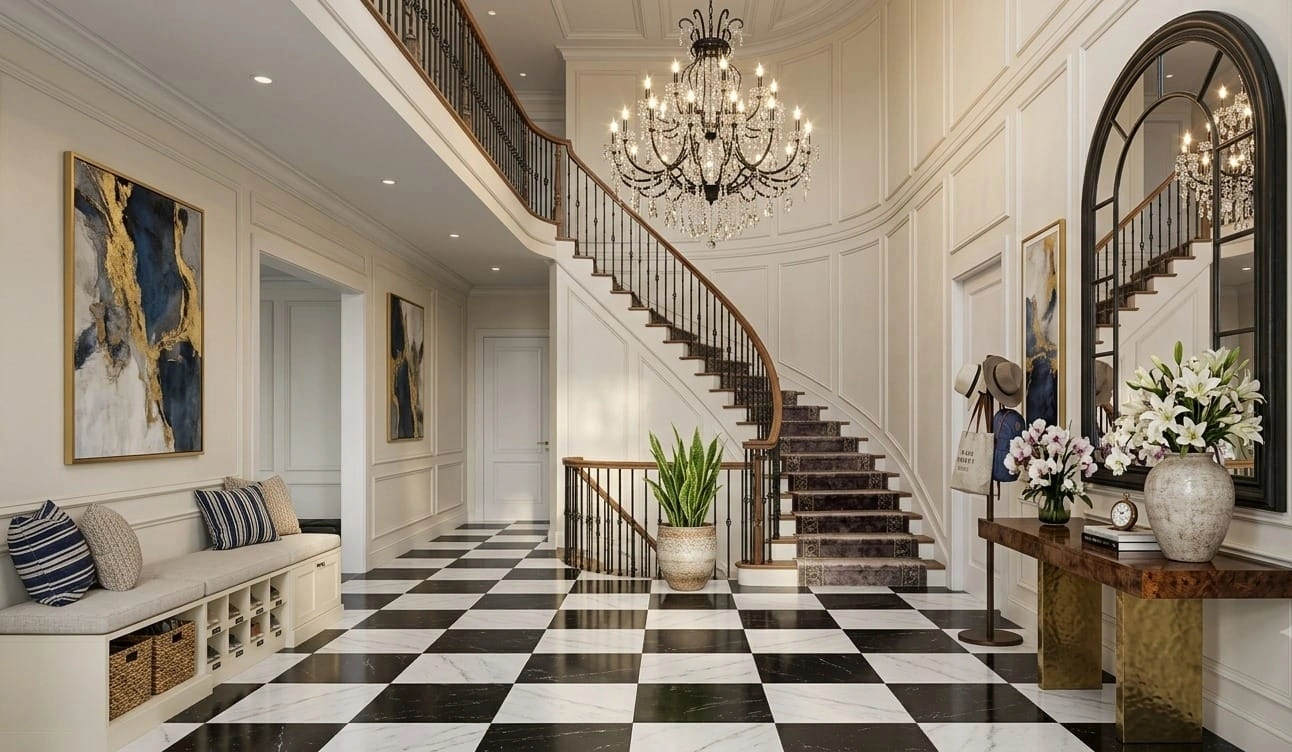
I redid my own hallway three times before I got it right. First attempt: a huge console table that made the space feel like a hallway in a furniture showroom, not a house. Second attempt: I went cheap on a runner rug and it curled at the edges within two months. Third time, I finally asked the right questions first — how much traffic does this space actually get, and who’s walking through it every day. That’s the part most guides skip.
This one won’t. You’ll get 15 real hallway entrance decor ideas, what each one costs, what material actually survives daily use, and which ones I’d skip if I were doing it again.
Entryway, Foyer, Hallway, Mudroom — Which One Do You Actually Have?
An entryway is the first few feet inside your door, a foyer is a larger and more formal version of that, a hallway connects rooms without necessarily having its own door, An entryway is the area just inside your front door, while a mudroom is designed to keep dirt and clutter contained. Knowing which one you’re actually decorating changes what furniture and materials make sense.
These two terms are often confused with each other. They’re not, and it changes what you should buy.
An entryway is just the first few feet inside your door. A foyer is a bigger, often more formal version — think a home with a proper front hall. A hallway connects rooms and might not have a door at all. A mudroom is built for mess: boots, leashes, wet umbrellas.
If you’ve got a mudroom already, you don’t need heavy storage furniture in your entryway too. If you don’t, your entryway is your mudroom whether you planned it that way or not. Plan storage accordingly.
Also check: Room Decor Ideas for Baby Welcome
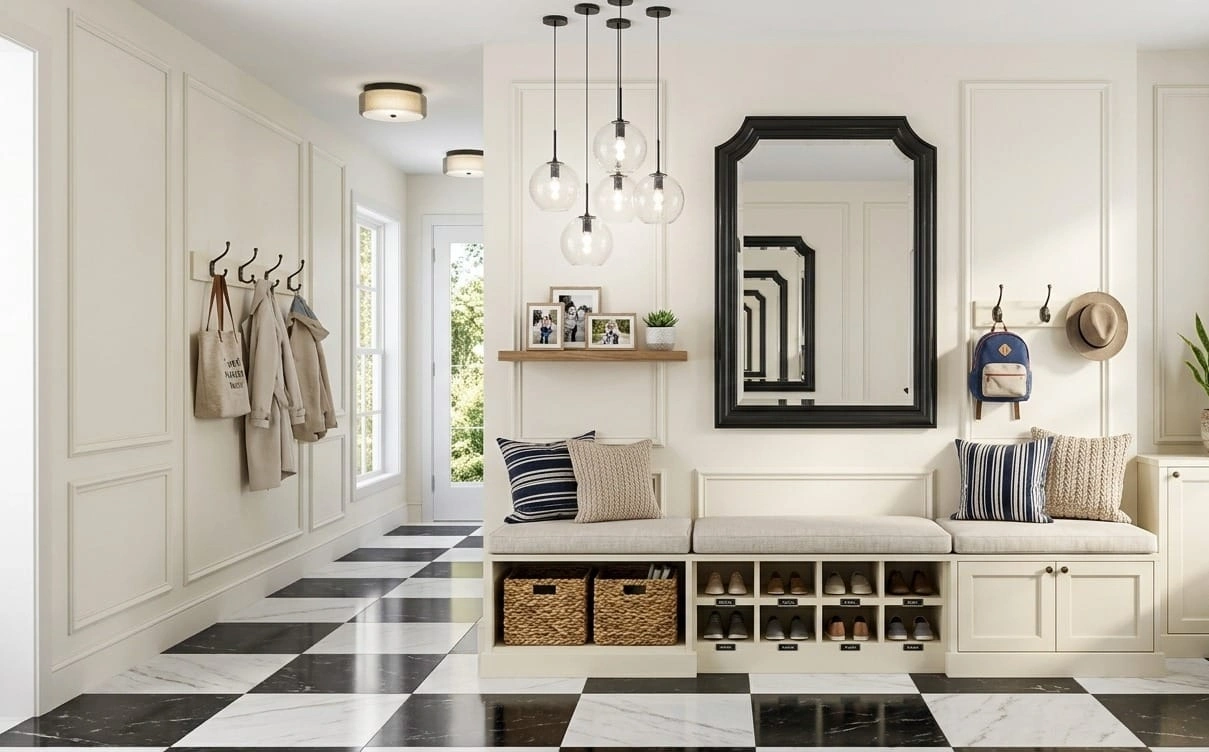
Which Hallway Style Should You Choose?
The right hallway style depends on four things: your space’s width, how much natural light it gets, who lives in your home, and your real budget. A narrow, dark rental hallway with kids calls for something completely different than a wide, bright foyer in a family-free home. Match the style to the space, not the trend.
Before picking a look, answer these:
- How wide is the space? Under 3 feet, skip anything freestanding — wall-mounted only.
- How much natural light? Dark hallway means light colors and mirrors do real work, not just decoration.
- Who lives here? Toddlers and dogs change the material conversation completely.
- What’s your real budget? Not your dream budget. The one you’ll actually spend.
| Style | Best For | Light Needed | Budget Level | Upkeep |
| Modern Minimalist | Small/narrow spaces | Any | Low-Mid | Low |
| Farmhouse | Family homes | Any | Mid | Medium |
| Traditional | Larger foyers | Bright | Mid-High | Medium |
| Boho | Renters, apartments | Any | Low | Low |
| Scandinavian | Dark hallways | Low OK | Low-Mid | Low |
| Coastal | Any home | Bright | Mid | Medium |
| Industrial | Lofts, open plans | Any | Mid | Low |
| Mid-Century | Design-forward homes | Any | Mid-High | Low |
| Transitional | Most homes | Any | Mid | Medium |
| Maximalist | Statement lovers | Any | High | High |
| Japandi | Calm-seekers | Bright | Mid | Low |
| Vintage/Antique | Character homes | Any | Mid-High | High |
| Glam/Art Deco | Formal entries | Bright | High | Medium |
| Cabin/Rustic | Mountain homes | Any | Mid | Medium |
| Family-Friendly | Homes with kids | Any | Low-Mid | High (by design) |
(Data suggestion: if available, insert a small bar chart here showing average spend by style, sourced from a home-renovation cost report.)
15 Hallway Entrance Decor Ideas (With Real Numbers)
1. Modern Minimalist
Clean lines, one or two colors, nothing extra on the walls. This is the one I’d recommend to anyone who’s tired before they’ve even started decorating.
From my experience, a single floating shelf paired with one large mirror works best. That’s genuinely enough. Clients who try to add three more pieces “to fill the space” almost always end up removing them within a year.
| Item | Top Material | Budget | Mid-Range | Splurge | Where to Buy |
| Floating shelf | Solid oak | $30 | $80 | $200+ | IKEA, Floyd, local carpenter |
| Mirror | Metal-framed glass | $40 | $150 | $400+ | Target, CB2, West Elm |
| Wall hook rail | Powder-coated steel | $20 | $50 | $120 | Amazon, Schoolhouse |
Pros:
- Cheapest style to get right
- Almost impossible to overcrowd by accident
- Works in any width of hallway
Cons:
- Can feel cold without a rug or plant
- Doesn’t hide clutter — you need discipline here, not decor
- Boring if you crave visual interest
How to buy the material: Check the shelf bracket weight rating before you buy — cheap ones sag within a year under books or bags. Ask for the number, don’t guess.
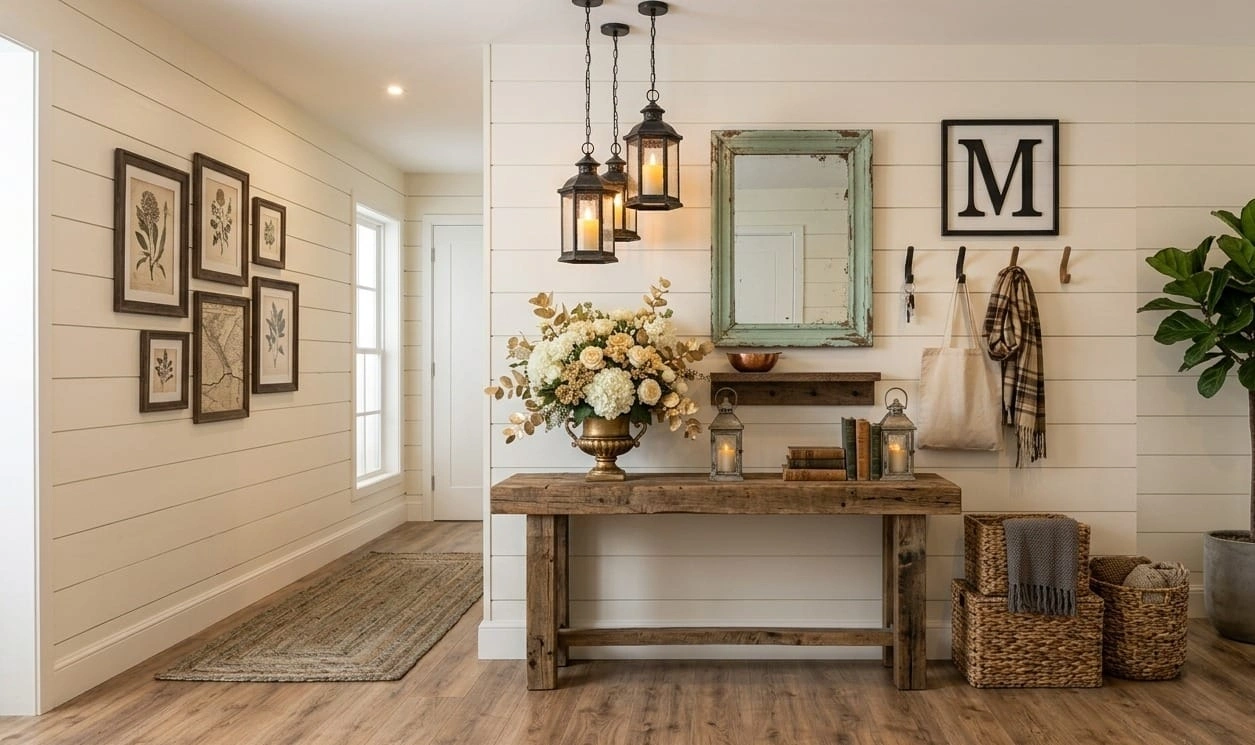
2. Farmhouse / Rustic
Reclaimed wood, black metal hardware, a bench you can actually sit on to put your shoes on.
I put a farmhouse bench in my sister’s house two years ago. Her kids still use it every single morning, and it’s the one piece of furniture in that house that’s never been “the thing we’re replacing next.”
| Item | Top Material | Budget | Mid-Range | Splurge | Where to Buy |
| Entry bench | Reclaimed pine | $90 | $220 | $600+ | Wayfair, local reclaimed-wood shops |
| Wall hooks | Black cast iron | $15 | $40 | $90 | Home Depot, Etsy |
| Runner rug | Jute or wool blend | $60 | $150 | $400 | Ruggable, Lorena Canals |
Pros:
- Hides scuffs and dings well, good for busy families
- Bench doubles as storage if you buy one with a lid
- Ages well instead of looking dated
Cons:
- Reclaimed wood can be pricier than it looks
- Not a fit for very formal or modern homes
- Heavier pieces are hard to move once placed
One thing to check before buying: reclaimed wood should smell like wood, not like sealant. A heavy chemical smell means it’s been over-treated and won’t age the way real reclaimed wood does.
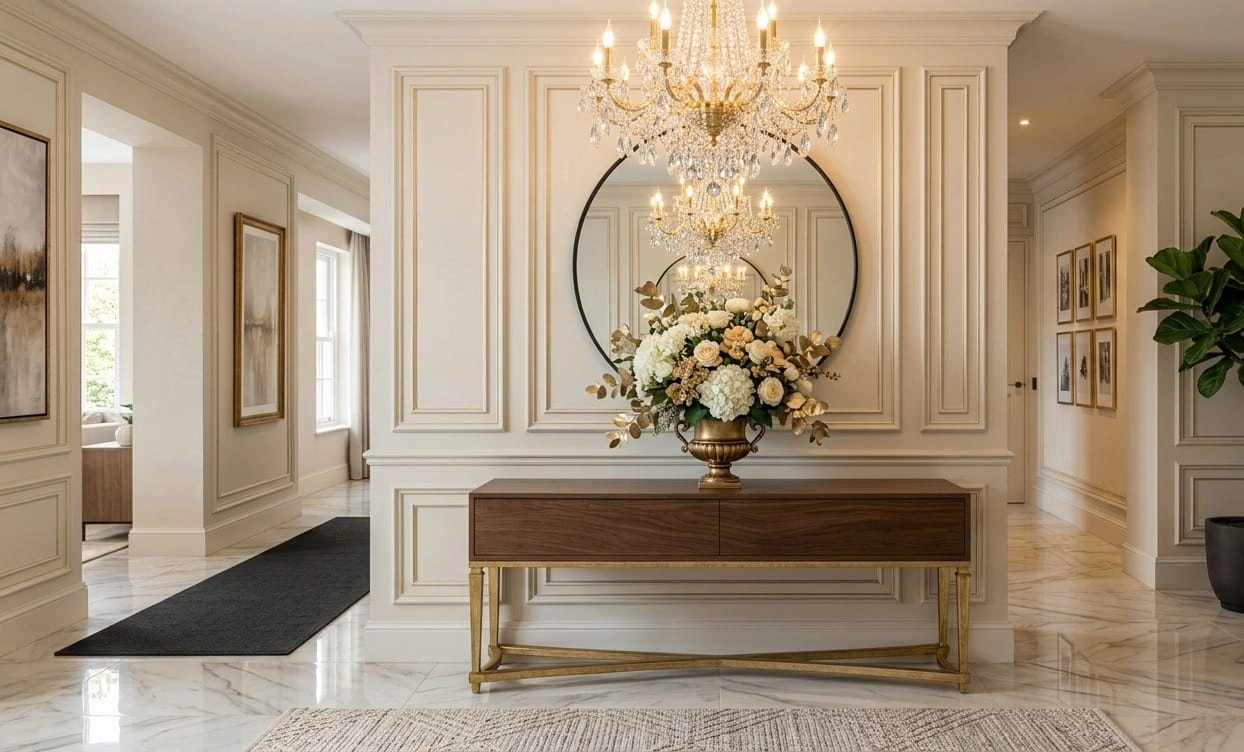
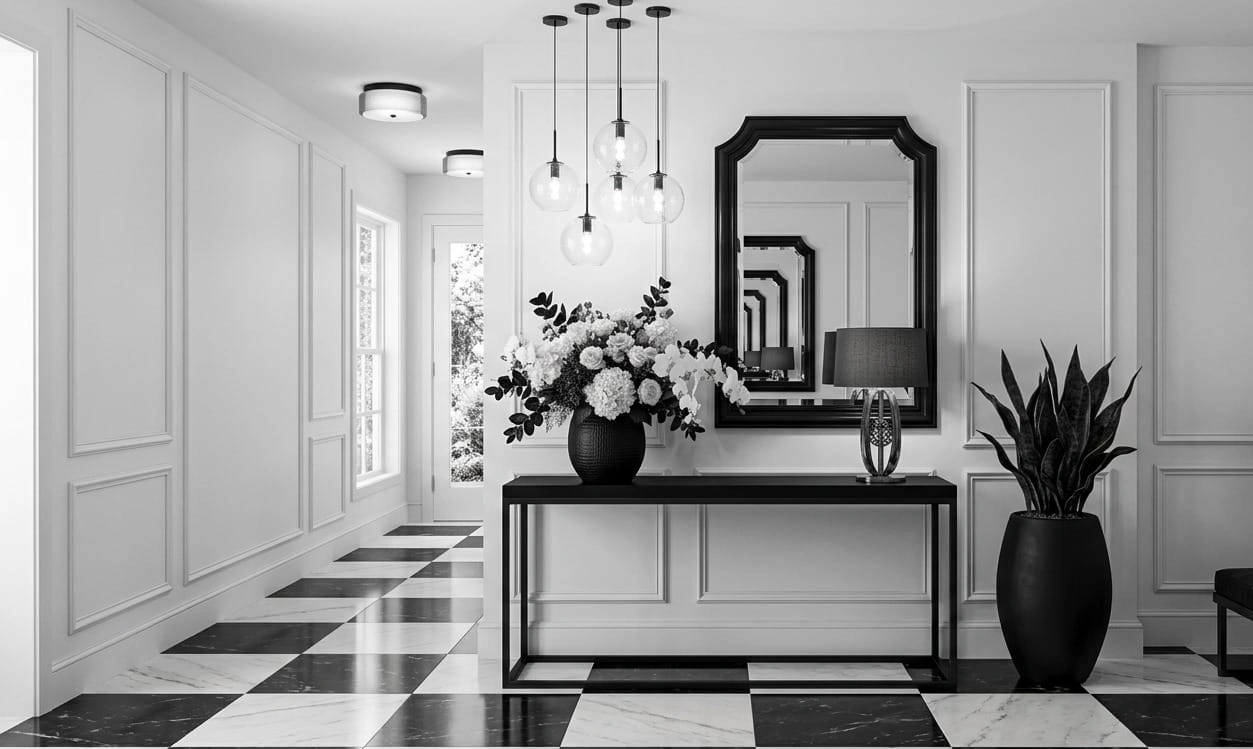
3. Traditional / Classic
Wainscoting, warm wood tones, a proper console table with a lamp on it.
Pros:
- Timeless — won’t look dated in five years
- Adds real resale value in traditional-style homes
- Handles larger, formal foyers well
Cons:
- Needs more space to not feel stuffy
- Higher upfront cost, especially with millwork
- Can feel mismatched in a modern-build home
| Item | Top Material | Budget | Mid-Range | Splurge | Where to Buy |
| Console table | Solid wood | $150 | $400 | $1,200+ | Pottery Barn, Arhaus |
| Wainscoting | MDF panel | $200 (DIY kit) | $600 | $2,000+ (custom) | Home Depot, local carpenter |
| Table lamp | Ceramic base | $30 | $90 | $250 | Target, Serena & Lily |
How to buy the material: MDF wainscoting kits are fine for dry hallways, but skip them near an exterior door — humidity swells MDF over a couple of years. Solid wood costs more but won’t warp.
4. Bohemian
Layered rugs, macrame, mixed textures, plants. This one’s forgiving if your hallway is a weird shape.
Pros:
- Cheapest way to add personality fast
- Great for renters — mostly removable decor
- Hides an “unfinished” feeling hallway well
Cons:
- Can tip into cluttered-looking if you don’t edit
- Textiles need more frequent cleaning
- Harder to keep looking intentional over time
| Item | Top Material | Budget | Mid-Range | Splurge | Where to Buy |
| Layered rug | Cotton + jute | $40 | $100 | $300 | Rugs USA, Etsy |
| Wall hanging | Macrame cotton | $20 | $60 | $150 | Etsy, World Market |
| Plant + stand | Faux or real greenery | $15 | $50 | $120 | Trader Joe’s, The Sill |
Worth knowing before you buy: real jute sheds for the first few weeks — that’s normal, not a defect. If a seller promises zero shedding, it’s likely a synthetic blend. There’s nothing wrong with that—just know what you’re buying.
5. Scandinavian
Pale wood, white walls, one deliberate accent color. Built for hallways with weak natural light.
Pros:
- Genuinely the best style for dark hallways
- Low-maintenance, minimal styling upkeep
- Easy to keep looking clean without much effort
Cons:
- Can look sterile without a warm accent
- Pale materials show scuffs faster
- Limited if you want a “cozy” feeling entry
| Item | Top Material | Budget | Mid-Range | Splurge | Where to Buy |
| Wall mirror | Round, light wood frame | $35 | $100 | $250 | IKEA, Article |
| Bench | Pale ash wood | $70 | $180 | $450 | IKEA, Design Within Reach |
| Wall sconce | Matte white or brass | $25 | $70 | $180 | Schoolhouse, Amazon |
How to buy the material: Ash and beech both bruise less than pine at this price point. If a “Scandinavian” bench feels light as cardboard when you lift a corner, it’s likely a soft pine that’ll dent fast.
6. Coastal / Nautical
Whites, blues, natural rope and rattan textures.
Pros:
- Bright, welcoming, good for entryways with a window
- Rattan and jute wear well in humid climates
- Easy to source affordably
Cons:
- Can feel themed rather than designed if overdone
- Not a natural fit for landlocked, formal homes
- Rope details fray faster in high-traffic spots
| Item | Top Material | Budget | Mid-Range | Splurge | Where to Buy |
| Rattan mirror | Natural rattan | $30 | $90 | $220 | Target, Serena & Lily |
| Storage basket | Seagrass | $20 | $50 | $110 | Amazon, World Market |
| Runner | Woven cotton | $35 | $90 | $200 | Ruggable |
Quick test before you buy: press a fingernail into rattan before buying — real rattan gives slightly and springs back; a stiff, plasticky feel means it’s a cheaper resin substitute that’ll crack over time.
7. Industrial
Black metal, exposed brick or brick-look panels, Edison bulbs.
Pros:
- Strong style statement for loft-style homes
- Metal furniture handles daily wear well
- Pairs easily with almost any wall color
Cons:
- Can feel cold in a small, low-light hallway
- Metal furniture is heavier to move or return
- Not a fit for cottage or traditional-style homes
| Item | Top Material | Budget | Mid-Range | Splurge | Where to Buy |
| Metal shelf unit | Powder-coated steel | $60 | $150 | $400 | Amazon, CB2 |
| Pendant light | Black metal, Edison bulb | $25 | $80 | $200 | Home Depot, Schoolhouse |
| Brick-look panel | PVC or MDF veneer | $50/panel | $90/panel | Real brick veneer $300+ | Home Depot |
How to buy the material: Real brick veneer is heavy — confirm your wall can support it before buying, especially on drywall. PVC panels are lighter and fine for renters.
Also Read: Budget Friendly Wall Decor ideas For Upcoming Event
8. Mid-Century Modern
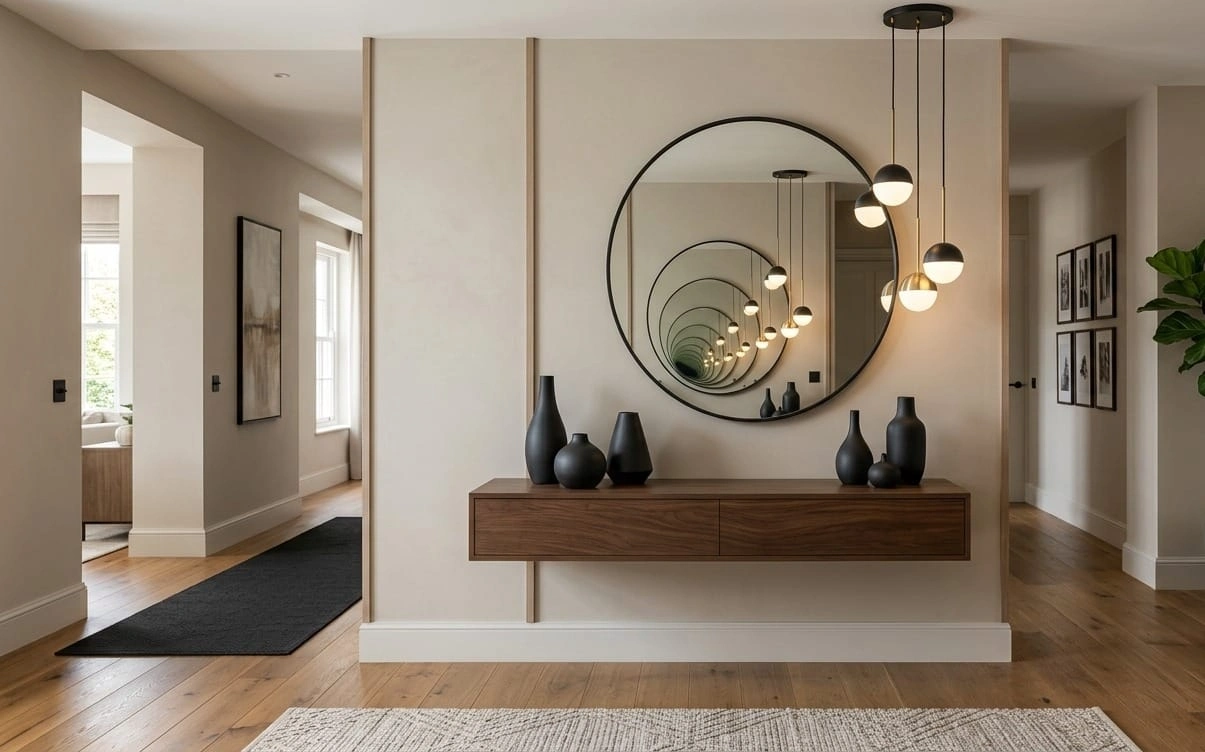
Tapered wood legs, warm walnut tones, simple geometric shapes.
Pros:
- Holds resale value better than most trend-driven styles
- Furniture tends to be well-built and durable
- Works in both small and larger entries
Cons:
- Authentic vintage pieces are expensive
- Reproductions vary wildly in quality
- Can look dated if paired with the wrong accent colors
| Item | Top Material | Budget | Mid-Range | Splurge | Where to Buy |
| Console table | Walnut veneer | $120 | $350 | $900+ (real walnut) | Article, vintage shops |
| Mirror | Sunburst, wood/metal | $40 | $110 | $280 | Etsy, West Elm |
| Table lamp | Teak base | $35 | $90 | $220 | Article |
Quick test before you buy: tap the legs — solid wood sounds dense, veneer over particleboard sounds hollow. Both are fine at the right price, just don’t pay solid-wood prices for veneer.
9. Transitional
A blend of traditional shapes with modern, simpler finishes. The best option when you’re unsure what to choose.
Pros:
- Flexible — works with almost any other room’s style
- Easiest to resell a home with, since it appeals broadly
- Doesn’t date as fast as trend-heavy styles
Cons:
- Can feel a little “showroom generic” if you’re not careful
- Requires more thought to make it feel personal
- Middle-of-the-road pricing on most pieces
| Item | Top Material | Budget | Mid-Range | Splurge | Where to Buy |
| Console table | Wood + metal mix | $100 | $280 | $700 | Pottery Barn, Crate & Barrel |
| Runner rug | Wool blend | $50 | $140 | $350 | Ruggable |
| Wall art | Framed print | $20 | $70 | $200 | Society6, local artists |
10. Maximalist / Eclectic
Bold wallpaper, mixed patterns, a gallery wall that actually tells a story.
Pros:
- The most memorable style on this list, hands down
- A smart way to make use of items you already have.
- Endless room to keep adding personality over time
Cons:
- Easy to overdo — needs real editing discipline
- Higher cost if wallpaper is involved
- Harder to sell a home styled this boldly
| Item | Top Material | Budget | Mid-Range | Splurge | Where to Buy |
| Wallpaper | Vinyl-coated | $40/roll | $90/roll | $200+/roll | Spoonflower, Anthropologie |
| Gallery frames | Mixed wood/metal | $10 each | $30 each | $80 each | HomeGoods, Framebridge |
| Statement rug | Patterned wool | $80 | $200 | $500+ | Rugs USA |
How to buy the material: Vinyl-coated wallpaper wipes clean, which matters in a hallway. Paper-only wallpaper looks nicer up close but stains permanently from a single muddy handprint.
11. Japandi
Japanese simplicity meets Scandinavian warmth. Natural materials, very little clutter, calm tones.
Pros:
- Genuinely calming to walk through daily
- Low-maintenance once set up
- Ages gracefully, rarely looks dated
Cons:
- Needs good light to not feel flat
- Limited color palette isn’t for everyone
- Quality natural-wood pieces cost more
| Item | Top Material | Budget | Mid-Range | Splurge | Where to Buy |
| Low bench | Ash or oak | $80 | $220 | $600 | Article, Muji |
| Paper lantern light | Washi paper | $30 | $70 | $150 | Noguchi-style retailers |
| Ceramic vase | Stoneware | $15 | $45 | $120 | Etsy |
12. Family-Friendly / Kid-Proof
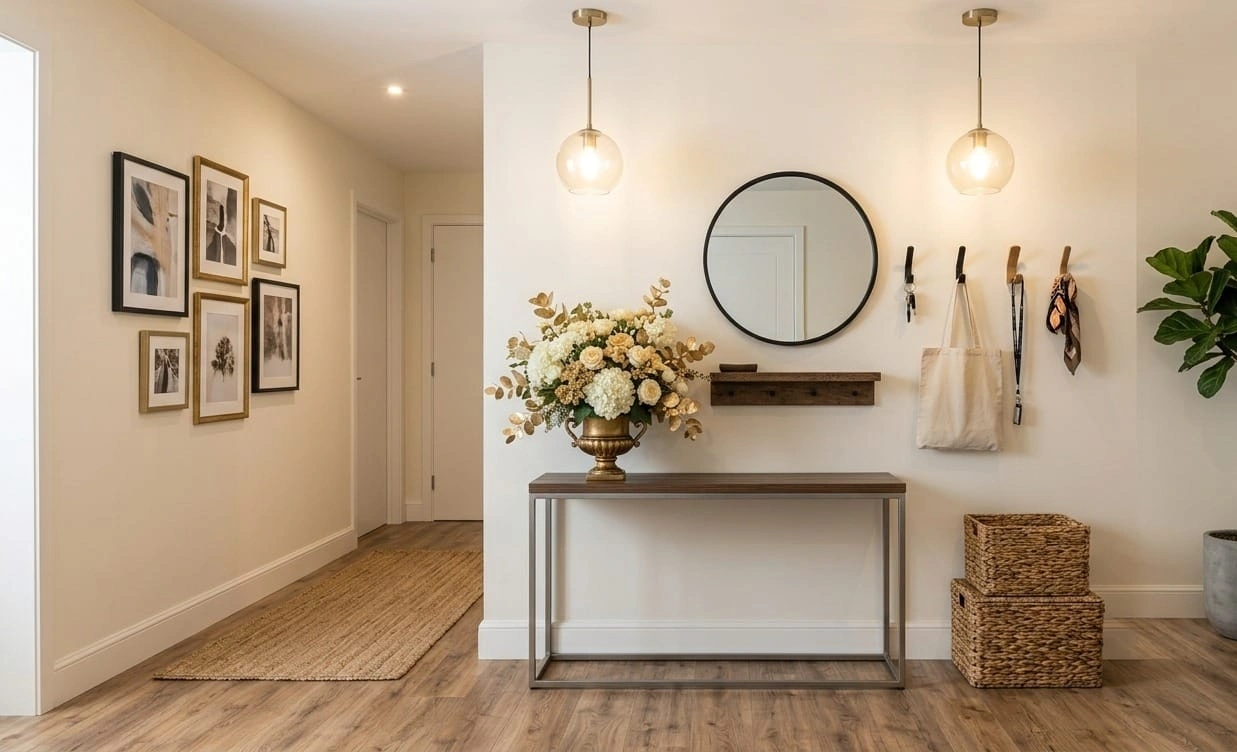
Built to survive backpacks, muddy shoes, and two kids racing through at once.
I’ve set this one up for more clients than any other style on this list, honestly, because it solves a real daily problem instead of just looking nice in photos.
Pros:
- Hooks at kid height mean kids actually use them, unprompted
- Wipeable finishes save real cleaning time
- Shared photo wall works for both a boy’s and a girl’s rooms without picking sides on color or theme
Cons:
- Less “showroom pretty,” more lived-in looking
- Storage baskets need regular sorting or they become junk piles
- Durable materials cost a bit more upfront
| Item | Top Material | Budget | Mid-Range | Splurge | Where to Buy |
| Low hook rail | Powder-coated metal | $15 | $40 | $90 | Amazon, IKEA |
| Storage bench | Laminate or solid wood | $70 | $180 | $450 | IKEA, Wayfair |
| Boot tray | Rubber | $10 | $25 | $60 | Home Depot, Amazon |
How to buy the material: Laminate finishes with a textured (not glossy) top hide scratches far better than glossy laminate, which shows every scuff within weeks in a house with kids.
13. Vintage / Antique
Real found pieces, patina, a mirror with actual age to it.
Pros:
- Genuinely one-of-a-kind, nobody else has your exact piece
- Often better-built than modern furniture at the same price
- Great conversation piece for guests
Cons:
- Hunting for pieces takes real time
- Condition varies — always inspect in person if you can
- Repairs (regluing, rewiring old lamps) add hidden cost
How to buy the material: Check joints on antique furniture for stability before buying — wobble at a joint usually means old glue has failed, which is fixable but adds cost you should factor into the price you’re willing to pay.
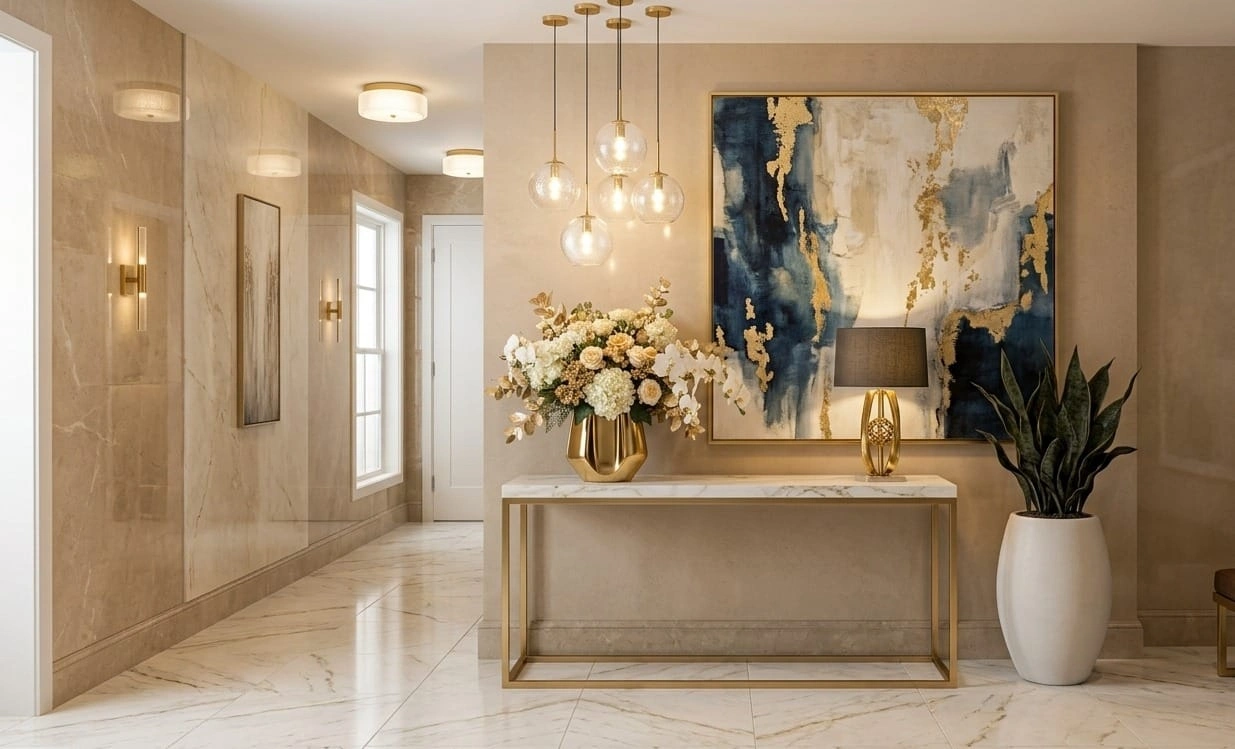
14. Glam / Art Deco
Mirrored surfaces, brass, geometric patterns, a bit of drama.
Pros:
- Makes a strong first impression for guests
- Great for formal or larger entries
- Brass and mirror finishes wear well long-term
Cons:
- Expensive to do well
- Shows fingerprints and dust more than other styles
- Needs a fairly bright entry to actually shine
How to choose the material: Genuine brass feels heavier and cooler to the touch than brass-plated metal, and it won’t chip and expose a different color underneath over time.
15. Mountain / Cabin Rustic
Heavy timber, stone accents, warm plaid or wool textiles.
Pros:
- Extremely durable materials, built for heavy use
- Cozy feeling that suits cold climates well
- Hides dirt and scuffs naturally
Cons:
- Can feel heavy or dark in a small hallway
- Not a fit for warm-climate or modern-build homes
- Stone accents add real installation cost
Myth vs. Fact: Hallway Entrance Decor
Myth: A nice entryway needs expensive furniture. Fact: Most of the styles above look their best with one well-chosen piece, not a full furniture set. My Scandinavian client spent $265 total and it out-performed several $2,000 foyers I’ve seen.
Myth: A small hallway can’t handle bold decor. Fact: Small spaces often handle bold wallpaper or a strong color better than large ones, because there’s less of it to overwhelm the eye.
Material & Buying Guide (Across All Styles)
Flooring
- Tile: most durable, $3-$12/sq ft installed. Best for entries that see wet shoes.
- Engineered wood: warmer look, $6-$15/sq ft. Handles moderate traffic well.
- Vinyl plank: budget-friendly, $2-$7/sq ft, genuinely tough for the price.
Wall treatments
- Paint: cheapest, easiest to redo. Budget $30-$60/gallon for a durable eggshell finish — flat paint scuffs too easily in a hallway.
- Wallpaper: $40-$200+/roll, pick vinyl-coated for wipeability.
- Wainscoting: $200 DIY kits up to $2,000+ custom.
Furniture materials, ranked by how they actually hold up
- Solid wood — most durable, priciest, ages well
- Engineered wood/veneer — good middle ground if built well
- Metal — very durable, cold to the eye alone, pairs well with wood
- Laminate — cheapest, fine for low-traffic pieces, weak for high-use benches
Buying guide checklist:
- Check weight limits on any wall-mounted piece before buying
- Ask what’s underneath a veneer or laminate finish
- Buy rugs one size larger than you think you need — small rugs look like an afterthought
- Test drawer slides and hinges in person when possible, not just from photos
Age-Specific & Household Recommendations
- Toddlers: rounded corners, hooks no higher than 30 inches, nothing breakable within reach
- Teens: a dedicated drop zone for bags and shoes, one wall they’re allowed to personalize
- Pet owners: a wipeable boot tray, leash hook at the door, washable rug
- Seniors: non-slip flooring, brighter lighting than you think you need, a sturdy piece to hold onto near steps
Lighting Ideas for a Hallway Entrance
Overhead fixtures work for wide entries. Wall sconces save floor space in narrow ones. If your hallway has zero natural light, skip anything dim and “moody” — a warm-white bulb at 800+ lumens does more for the space than any fixture choice.
Also check this article: Birthday Decor ideas with photo.
Comparison: Decor Elements and Alternatives
| Feature | Runner Rug | Bench | Wall Shelf |
| Cost | $50-$300 | $70-$600 | $30-$200 |
| Space needed | Floor-length only | 3+ ft of wall | Minimal |
| Storage | None | Yes, if lidded | Light only |
| Best for | Adding warmth, sound dampening | Sitting to change shoes | Very narrow hallways |
Safety Section (Read This Part)
This is the section most guides skip, and it’s the one that actually matters most if you have kids.
- Anchor every mirror and shelf to a wall stud, not just drywall anchors. A leaning entry mirror is one of the more common home injury causes for young kids — it’s not dramatic to take this seriously, it’s just basic.
- Use a non-slip pad under any rug on hard flooring.
- Keep the walkway itself completely clear — no bins, no shoes left mid-path.
- Route lighting cords along the wall, never across the floor.
- Check the weight rating on wall hooks before hanging bags — a hook rated for 5 lbs holding a stuffed backpack will eventually pull out of the wall.
Mistakes to Avoid
- Buying furniture too big for the width, then living with a hallway you have to turn sideways to pass through
- Painting a dark, low-light hallway an even darker color
- Skipping storage entirely and letting shoes pile up by the door
- Leaving a mirror or shelf unanchored
- Not using a rug pad — the rug slips and wears out faster
- Overcrowding the walls until nothing stands out
Seasonal Hallway Entrance Decor Advice
Swap in a heavier, warmer-toned runner for winter and a lighter woven one for summer. Add a boot tray from November through March, remove it after — it’s a small thing that keeps the entry looking intentional instead of purely functional. A simple wreath or seasonal accent by the door goes a long way for very little cost.
Expert Tips
- Scale matters more than style. A gorgeous console table in too small a hallway just reads as a mistake.
- A mirror placed across from your main light source doubles the brightness of a dark entry, no extra bulbs needed.
- Layer at least two textures — wood and metal, or wool and cotton — even in a minimal style. Flat, single-texture spaces read as unfinished.
- One statement piece per hallway. Two statement pieces compete with each other and neither wins.
A Real Hallway Makeover
A client of mine had a narrow, dark rental hallway and a strict $300 budget. We went Scandinavian: a light wood bench, a round mirror opposite the one small window, and a jute runner. Total spend: $265. Her words when it was done: “I didn’t think this hallway could look like anything. Now it’s the first thing people mention when they walk in.” That’s the whole goal — not an expensive room, just one that finally works.
How Long Each Decor Idea Lasts
| Item | Typical Lifespan | Refresh Signal | Redo Cost |
| Paint | 5-7 years | Scuffs, yellowing | $100-$300 |
| Runner rug | 3-5 years | Flattened pile, fraying edges | $50-$300 |
| Wallpaper | 8-15 years | Peeling, fading | $200-$800 |
| Solid wood bench | 15+ years | Rarely needs replacing | Minor repair only |
| Wall hooks | 5-10 years | Loosening, rust | $15-$50 |
My Favorite Style, and Why
If I had to pick one for most people, it’s Scandinavian. It’s forgiving of low light, cheap to start, and doesn’t demand constant upkeep. I’ve set it up in three different narrow, dark rental hallways now, and it’s the only style on this list I’ve never had a client want to redo within the first two years.
FAQs
What should I put in my hallway entrance? At minimum: a mirror, some storage for shoes or bags, and a light source. Beyond that, a rug and one piece of wall art round it out without overcrowding a small space.
How much does it cost to decorate an entryway? A basic refresh runs $150-$400. A fuller makeover with furniture, rug, and lighting typically lands between $500 and $1,500, depending on materials chosen.
For context, a full foyer remodel involving new flooring, paint, and lighting averages around $3,500 nationally as of 2026, with most projects falling between $1,000 and $9,000 [Source: RenoCosts, 2026 foyer/entryway remodel data]. Most of what’s in this guide sits well under that, since it’s decor, not construction.
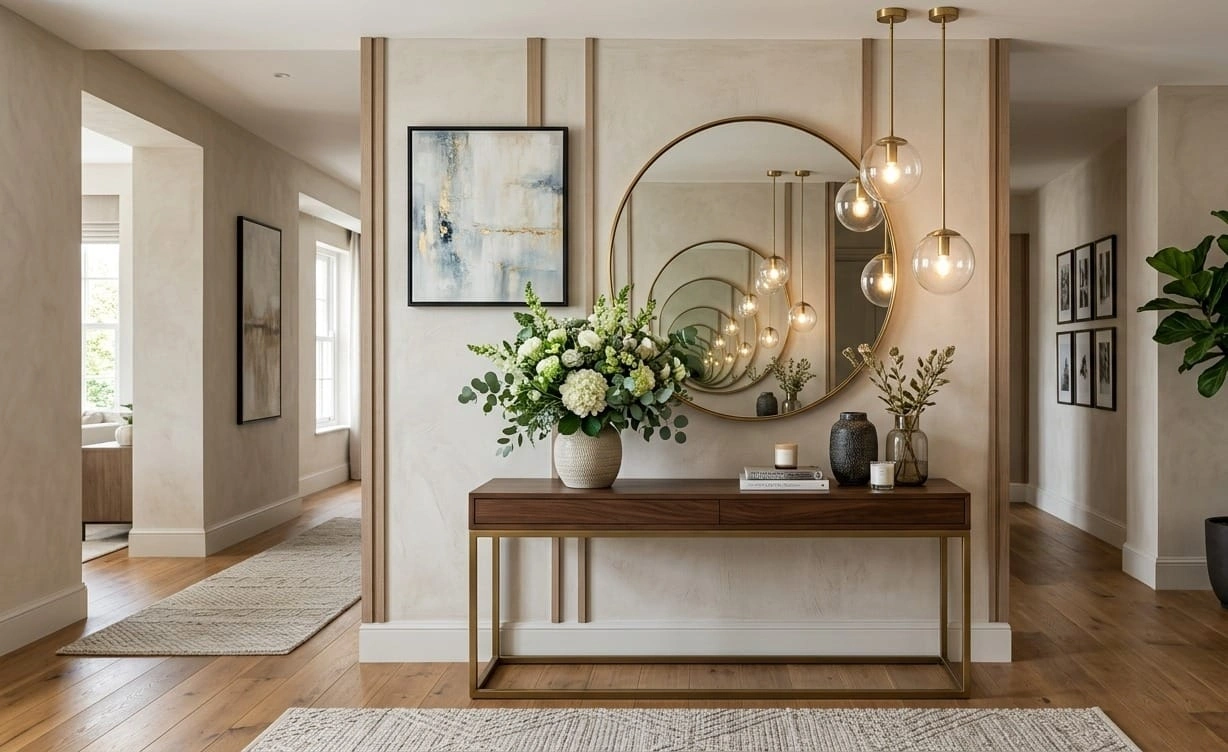
Is a rug or runner better for a hallway? A runner, in almost every case. Standard rugs rarely fit a hallway’s proportions well, and a runner protects flooring along the exact path people actually walk.
How do you decorate a hallway with no natural light? Use pale wall colors, add a mirror across from your main light fixture, and choose warm-white bulbs at 800+ lumens. Skip dark, moody colors here — they make a dim hallway feel smaller, not cozier.
Quick-Start Checklist
- Measure your hallway width before buying anything
- Pick one style from the table above based on light and household
- Buy the mirror or light fixture first — it fixes the biggest problem in most hallways
- Anchor anything wall-mounted properly
- Add the rug and one storage piece last, once the bones are right
If you only do one thing from this whole guide, anchor your mirror properly and get the lighting right. Everything else is decoration. Those two are safety and function, and they’re what actually make a hallway work every single day, not just in photos.
Whichever of these hallway entrance decor ideas you land on, from a $265 Scandinavian refresh to a full Traditional foyer with wainscoting, the same three things decide whether it lasts: the right material for your traffic level, furniture anchored properly, and lighting that actually solves the room’s biggest problem. Prices and trends shift year to year. Those three don’t.