

I’ve styled a lot of entryways over the years, and if there’s one wall in the house people get stuck on, it’s this one. It’s the first thing you see walking in and the last thing you see walking out — and somehow it’s also the wall everyone leaves half-finished for years.
This guide is everything I actually use when I plan a farmhouse entryway wall decorating project: the styles that hold up in real homes, what they genuinely cost, where to buy the materials, the mistakes that ruin a good idea, and — at the end — the one style I keep coming back to myself.
No fluff. Just what works.
What Is Farmhouse Entryway Wall Decor, Really?
Farmhouse entryway wall decor uses warm, slightly imperfect materials — reclaimed or distressed wood, a soft neutral palette, and black or aged-metal accents — to make the first wall you see feel cozy and lived-in rather than showroom-perfect.
At its core, farmhouse wall decor is about warmth over polish. Think reclaimed or distressed wood, a soft neutral palette (warm whites, greiges, soft taupe), and black or aged-metal hardware doing the accent work. It should feel a little imperfect — like it’s been lived in, not staged.
A quick way to tell the substyles apart:
- Classic farmhouse – whitewashed wood, vintage signs, galvanized metal
- Modern farmhouse – the same warmth, but cleaner lines and less clutter
- Industrial farmhouse – raw wood paired with black metal, exposed hardware
- Cottagecore – softer, more floral and vintage-romantic
If you want the warm, welcoming version without the clutter, modern farmhouse is almost always the safer long-term choice — trends move fast, and less “themed” decor ages better.
How Much Does Farmhouse Entryway Wall Decor Actually Cost?
I’ll be straight with you: budget is the first question every client asks, so it’s the first thing I’m answering.
Entryways are small spaces, which is good news for your wallet — even a full foyer refresh (flooring, paint, lighting) typically runs $1,000 on the low end, climbing toward $9,000 for one with custom storage and wainscoting, according to 2026 remodeling cost data from RenoCosts. Wall décor is just a small part of the overall budget.
Table 1 — Budget Tiers for Farmhouse Entryway Wall Decor
| Budget Tier | Price Range | What You Get | Best For |
| Low | $30–$100 | Thrifted frames, a small shelf, a DIY sign | Renters, first apartments |
| Mid | $100–$350 | Quality mirror, curated gallery wall, styled floating shelf | Most homeowners |
| High | $350–$1,000+ | Custom accent wall, statement mirror, built-in shelving | Long-term homeowners, full refresh |
If you’re stretching a decor budget across more than one room, my budget-friendly balcony decorating guide has a lot of the same low-cost, high-impact tricks that work just as well indoors.
8 Farmhouse Entryway Wall Decor Ideas (Materials, Costs, Pros, Cons & How-To)
These are the eight I actually recommend to clients — not because they’re trendy, but because I’ve watched them hold up over years, not just Instagram posts.
1. Gallery Wall
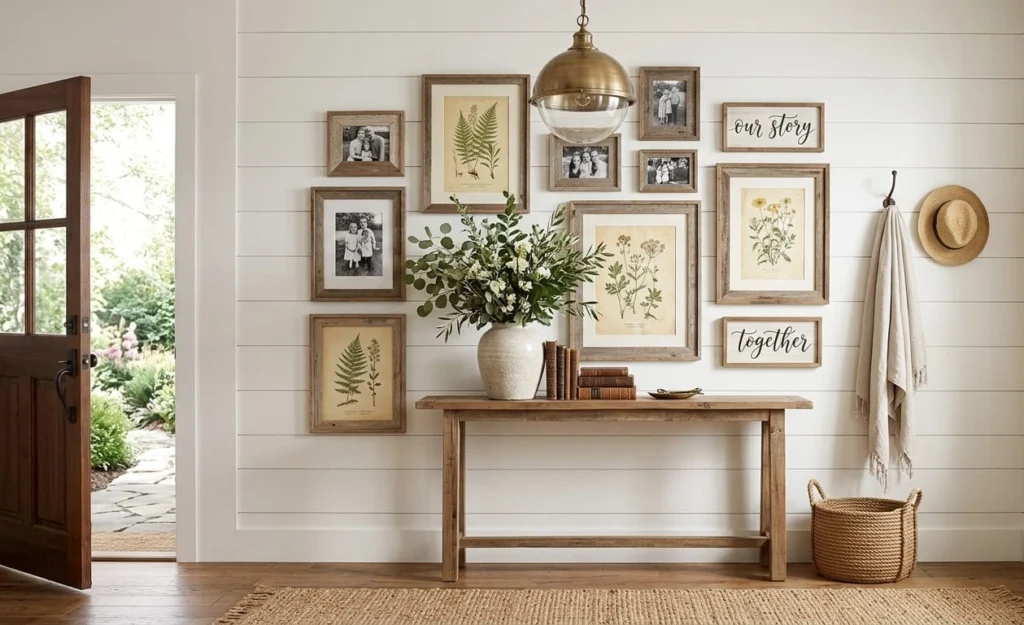
A curated cluster of frames — mixed sizes, one consistent color story — is still one of the fastest ways to make a blank entryway wall feel finished and personal.
Quick facts:
- Materials: wood or metal frames, mat board, picture-hanging strips or a French cleat system
- Where to buy: frame sets at HomeGoods/Target for value; individually sourced vintage frames on Etsy or at flea markets for character
- Typical budget: $80–$250 for 6–9 pieces
Pros:
- Highly personal — photos, art, and signs can all live together
- Easy to update piece by piece instead of replacing the whole thing
- Works in almost any entryway shape, narrow or wide
Cons:
- Takes real planning — a rushed layout looks cluttered fast
- Multiple hanging points means more wall damage if you rent
- Dusting/cleaning takes longer than a single piece
How to do it:
- Lay the arrangement out on the floor first
- Keep 2–3 inches between frames, consistent spacing throughout
- Anchor the visual center around eye level (57–60 inches from the floor)
- Use painter’s tape outlines on the wall before you commit to a single nail
Real talk: the first gallery wall I ever installed for a client, we hung it too high because we were “eyeballing it.” We had to patch four holes and start over at true eye level. Now I tape it out every single time — no exceptions.
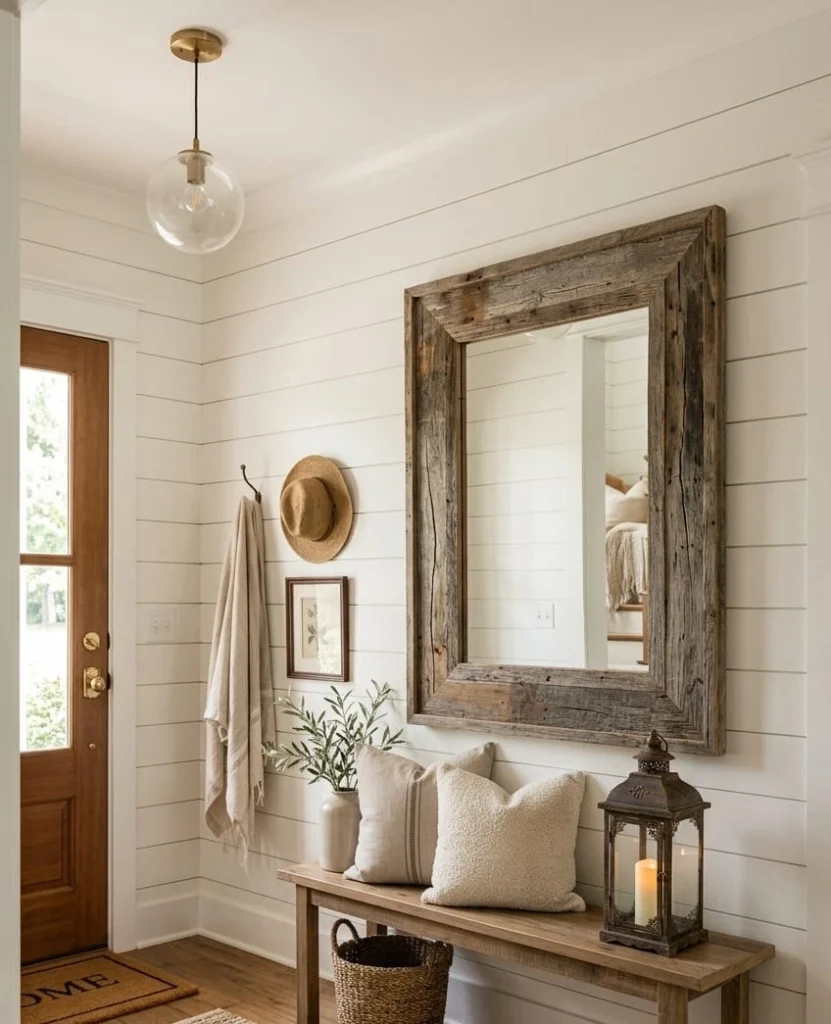
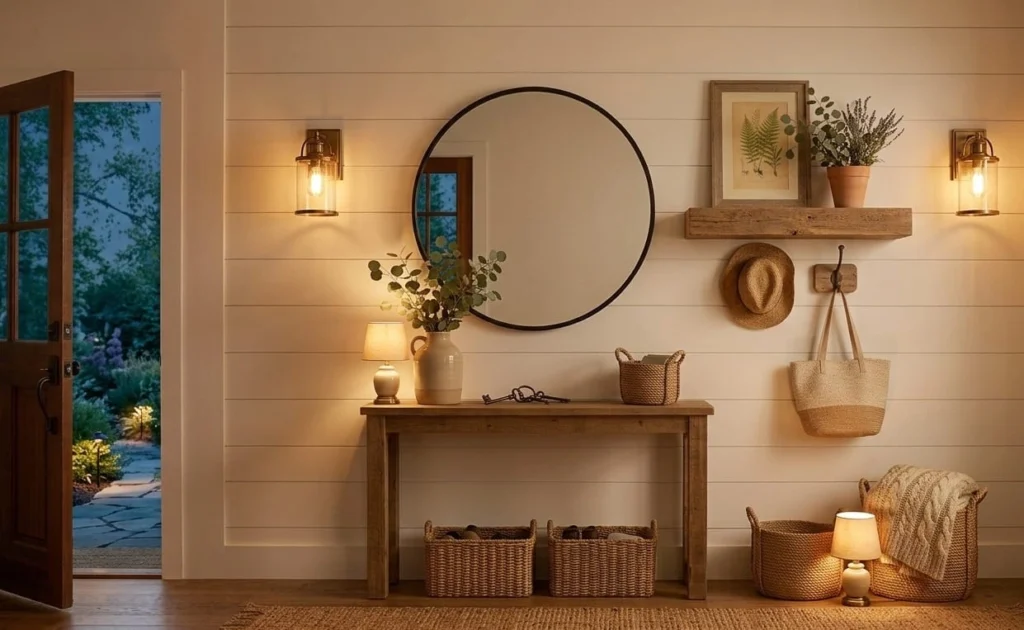
2. Statement Farmhouse Mirror
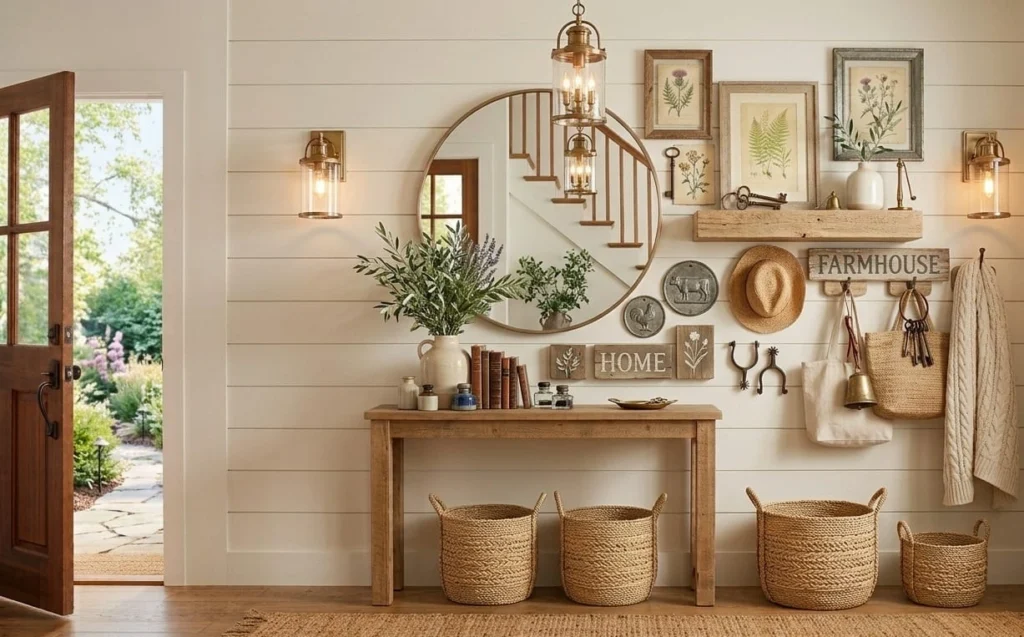
An oversized, wood-framed or black-framed mirror is my go-to recommendation for entryways that feel dark or cramped — it bounces light back into the space instantly.
Quick facts:
- Materials: wood frame or matte black metal frame, D-ring hangers, French cleat for anything over 25 lbs
- Where to buy: big-box retailers (Target, Walmart, World Market) for budget options; Etsy or local woodworkers for a custom farmhouse frame
- Typical budget: $60–$300 depending on size and frame material
Pros:
- Instantly makes small entries feel bigger and brighter
- One purchase, no ongoing styling maintenance
- Functional as well as decorative
Cons:
- A poor-quality mirror can warp reflections and look cheap
- Heavy mirrors need real hardware, not just a nail
- Limited personalization compared to a gallery wall
How to do it:
- Weigh the mirror before you buy hardware — don’t guess
- Locate a stud if at all possible; studs are typically spaced 16 or 24 inches apart
- If you can’t hit a stud, use anchors rated well above the mirror’s actual weight
- For anything heavy or oversized, a French cleat distributes weight evenly across the frame and is the safest method professionals use
Safety note (this matters more than people think): a simple nail in drywall — even into a stud — is rated for roughly 20 pounds, and most drywall-only anchors max out well below what a large farmhouse mirror actually weighs. Heavy-duty drywall picture hangers (like 3M’s CLAW hangers) can safely support up to 65 pounds without needing a stud or tools, but always check the manufacturer’s rating against your mirror’s real weight, not an estimate.
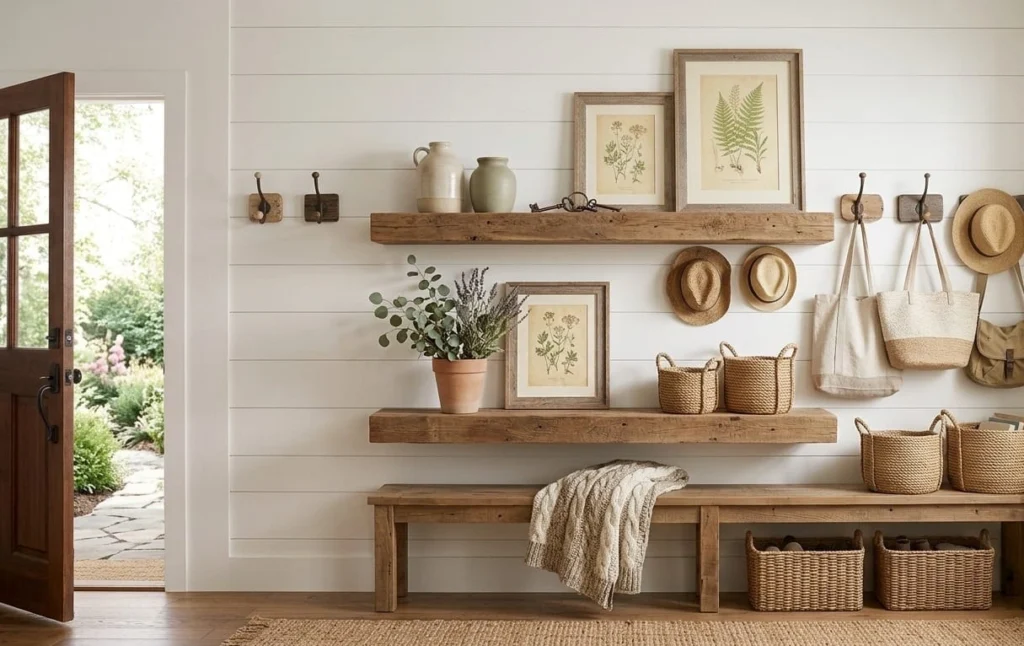
3. Wall-Mounted Coat Hooks + Bench Vignette
This is the style that earns its keep every single day — it’s decor and storage in one, which is exactly what a hardworking entryway needs.
Quick facts:
- Materials: wall-mounted hook rail (wood or black metal), small bench, woven baskets underneath
- Where to buy: IKEA or Home Depot for budget rails, Pottery Barn or Etsy for a more custom farmhouse look
- Typical budget: $70–$220
Pros:
- Solves real daily clutter (coats, bags, keys)
- Doubles as decor and function — great ROI
- Works beautifully in small or narrow entries
Cons:
- Needs to be installed securely — it holds real weight daily
- Can look cluttered if not edited regularly
- Less “art-forward” if you want a gallery-style statement
How to do it:
- Mount into studs wherever possible — this rail takes daily wear, not just static weight
- Hang at 60–66 inches for adult use, lower for a household with kids
- Pair with a slim bench underneath for the classic mudroom-meets-entryway look
4. Floating Wood Shelves with Styled Decor
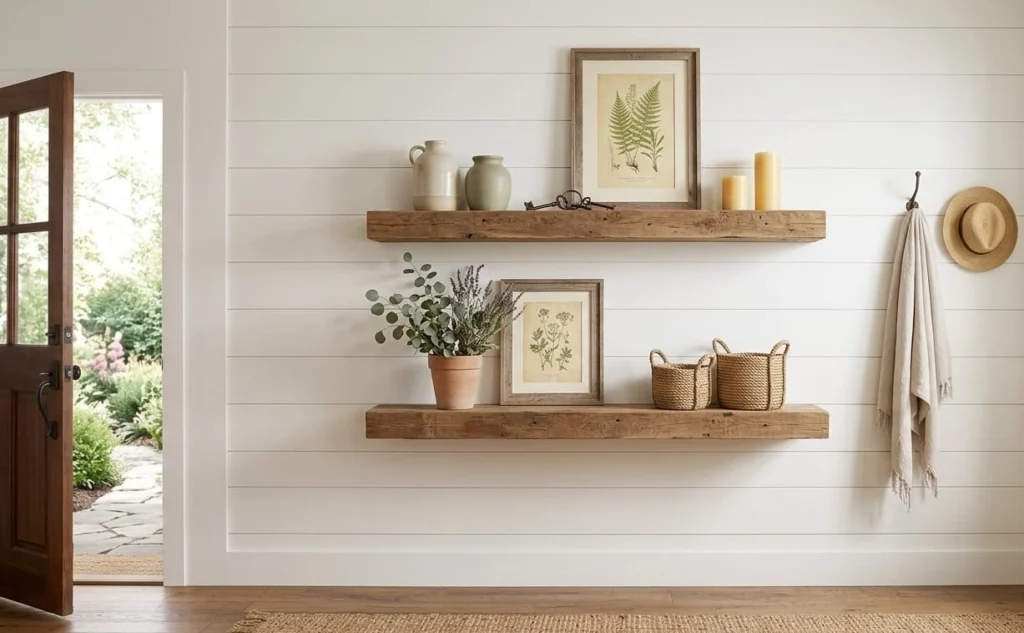
A single floating shelf, styled with 3–5 curated objects, is the easiest “renter-safe” farmhouse look I recommend — and it’s endlessly changeable.
Quick facts:
- Materials: solid wood or wood-veneer floating shelf, L-brackets or hidden floating hardware
- Where to buy: Home Depot/Lowe’s for basic shelves, Etsy for reclaimed wood with real character
- Typical budget: $25–$120
Pros:
- Cheapest way to get the farmhouse look on this list
- Easy to restyle seasonally without new holes
- Works in the smallest entryways
Cons:
- Limited weight capacity — no heavy decor
- Can look sparse if under-styled, or busy if overloaded
- Needs level installation or it reads as sloppy
How to do it:
- Install at eye level or slightly above eye line for visual impact
- Style in odd numbers (3 or 5 objects), varying height
- Anchor into at least one stud if the shelf will hold anything beyond very light decor
5. Shiplap or Board-and-Batten Accent Wall
This is the most transformative option on the list — and also the one I’ll give you the most honest take on, because the trend has genuinely shifted.
Quick facts:
- Materials: shiplap or board-and-batten panels, trim, paint or whitewash finish
- Where to buy: Home Depot/Lowe’s for standard panels, local millwork shops for custom profiles
- Typical budget: $500–$3,000 depending on wall size and finish, in line with what full foyer remodels typically budget for wainscoting or a feature-wall detail ($500–$3,000)
Pros:
- The single most dramatic before/after transformation available
- Permanent — no restyling needed year to year
- Adds real architectural value to the home, not just surface decor
Cons:
- Highest cost and labor of anything on this list
- Not renter-friendly at all
- Interior designers are increasingly split on plain shiplap as an accent wall — more on that below
How to do it:
- Measure and plan panel layout before cutting anything
- Prime and finish before installation for the cleanest edges
- Consider extending it floor-to-ceiling rather than a partial accent — designers now say a half-wall shiplap accent can read as unfinished, while a full wall feels intentional
Is shiplap actually out of style in 2026? Not entirely — but plain, partial-wall shiplap is starting to feel dated to many designers, who are steering clients toward more refined wood paneling and hand-applied plaster finishes instead. Design experts quoted in trade outlets like House Digest and Real Simple have been saying plain shiplap accent walls feel a little dated now, with buyers gravitating toward more refined, modern wall treatments. Interior designer Kelley Kolettis has described today’s wall treatments as taking a more sophisticated turn than the classic shiplap look. My honest take, from doing this professionally: shiplap isn’t dead, but doing it exactly like the 2015 farmhouse-craze version — thin white boards, partial wall, nothing else — is what looks dated now. Go full wall, use it in a mudroom or entry (a “working” space, which is exactly where designers say it still belongs), or pair it with a warmer, less stark white.
6. Vintage or Custom Wood Sign
A single wood sign — a family name, an address, a short welcome phrase — is the fastest way to add personality without committing to a full wall treatment.
Quick facts:
- Materials: solid or reclaimed wood, laser-cut or hand-painted lettering
- Where to buy: Etsy for custom orders (my top recommendation — the quality difference is real), craft-store DIY kits for a budget version
- Typical budget: $20–$150
Pros:
- Cheapest way to personalize the space
- Quick to install — usually a single hanging point
- Great gift-worthy option (housewarmings, new homeowners)
Cons:
- Can feel generic if it’s an overused phrase
- Limited visual impact on its own — often needs a supporting element
- Custom orders take lead time; don’t order the week you need it
7. Woven Wall Baskets or Macrame Hanging
This is the texture-builder — it softens all that wood and metal with something organic, and it’s having a real moment in warmer, more textured 2026 interiors.
Quick facts:
- Materials: woven rattan/seagrass baskets, macrame cord, wood dowel for hanging
- Where to buy: World Market and Target for baskets, Etsy for handmade macrame
- Typical budget: $20–$100
Pros:
- Adds texture without adding visual weight
- Very lightweight — easy, low-risk hanging
- Pairs with nearly every other style on this list
Cons:
- Can start to feel “boho” rather than farmhouse if overdone
- Needs occasional dusting (texture traps dust)
- Less substantial as a stand-alone statement
8. Seasonal Wreath + Rotating Wall Decor
The lowest-commitment option, and the one I recommend to almost every client as a “starter” piece while they plan the rest of the wall.
Quick facts:
- Materials: grapevine or fabric wreath base, seasonal florals/ribbon, a simple hook
- Where to buy: Michaels/Hobby Lobby for bases and supplies, Etsy for ready-made seasonal wreaths
- Typical budget: $15–$80 per season
Pros:
- Keeps the entryway feeling current all year
- Extremely low commitment and low cost
- Easiest single item to swap without any wall damage
Cons:
- Needs to be swapped regularly or it looks neglected
- Storage for off-season wreaths adds clutter elsewhere
- Not enough on its own for a fully “finished” wall
Which Farmhouse Wall Decor Style Should You Choose? (Comparison Table)
Table 2 — Style Comparison at a Glance
–$
| Style | Best For | Cost | Effort | Longevity |
| Gallery Wall | Personality + photos | $$ | Medium | Long-term |
| Statement Mirror | Small or dark entryways | Low | Long-term | |
| Coat Hooks + Bench | Function-first households | $$ | Low | Long-term |
| Floating Shelves | Renters, flexibility | $ | Low | Flexible/seasonal |
| Shiplap Accent | Full transformation | $$$ | High | Permanent |
| Wood Sign | Quick personality boost | $ | Low | Long-term |
| Woven/Macrame | Texture and softness | $ | Low | Medium-term |
| Wreath/Seasonal | Low-commitment starters | $ | Low | Short-term |
Small Entryway vs. Large Entryway: Space-Specific Recommendations
Space changes everything about what actually works — this is where a lot of Pinterest boards fall apart in real homes.
Small or narrow entryway:
- Choose vertical decor (tall mirror, slim shelf) over a wide gallery wall
- Stick to one statement piece rather than layering three styles
- Lighter frame tones keep a tight space from feeling boxed in
Open or larger foyer:
- Full gallery walls and oversized mirrors both have the room to breathe here
- Layer styles — bench, shelf, and wall art together — for a “designed” look
- This is where a shiplap or board-and-batten accent wall makes the most financial and visual sense
For entries doing double duty around a milestone — a nursery announcement wall near the front door, or a space you’re dressing up for a big family event — the same space-first thinking applies. If that’s on your radar, my guides on decorating for a baby’s homecoming and milestone birthday decorating walk through the same “plan around the space you actually have” approach.
Seasonal Farmhouse Entryway Wall Decor Ideas
I rotate a handful of small elements through the year rather than redoing the whole wall — it keeps things feeling fresh without extra holes or expense:
- Fall: a grapevine wreath, warm rust and cream tones
- Winter/holiday: garland along a shelf edge, subtle string lights, a seasonal sign
- Spring: dried or faux greenery, lighter linen textures
- Summer: pare it back — let the neutral wood and metal do the talking
Mistakes to Avoid (Read This Before You Hang Anything)
The most common mistake is guessing at weight and hardware instead of checking it — a plain nail in drywall is only rated for about 20 pounds, even in a stud, which is why heavy mirrors and shelves need real anchoring, not assumptions.
This is the section I wish more guides included, because it’s where I’ve seen good ideas go wrong.
- Guessing the weight limit. A basic nail into drywall is only rated for about 20 pounds, even driven into a stud. For anything heavier, use hardware rated well above your item’s actual weight — heavy-duty picture hangers can hold up to 65 pounds without a stud, but only when installed correctly.
- Skipping the stud finder. Studs are typically spaced 16 or 24 inches apart — always locate one before hanging anything over a few pounds.
- Drilling into rental walls without a plan. Command strips and claw-style hangers exist specifically so renters don’t have to choose between decor and their deposit.
- Overcrowding the wall. More isn’t more here — a wall with too many small, competing pieces reads as cluttered instead of curated.
- Wrong scale. A mirror or art piece that’s too small for the wall it’s on will always look like an afterthought, no matter how nice it is.
- Forgetting lighting. Even the best wall decor disappears in a dim corner — a simple sconce or picture light changes everything.
Expert Buying Guide — Top Materials and Where to Actually Buy Them
Here’s what I actually look for before recommending a purchase to a client:
- Wood quality: solid wood ages better and takes distressing well; veneer is fine for budget pieces but check the edges for peeling
- Mirror glass: thicker glass (4mm+) gives a truer reflection and less warping than ultra-thin budget mirrors
- Metal hardware finish: matte black and aged bronze are the most versatile farmhouse-adjacent finishes and age gracefully
- Big-box stores (Target, HomeGoods, Home Depot): best for budget basics and quick turnarounds
- Etsy and local makers: best for anything you want to feel custom — signs, mirrors, reclaimed wood shelves
- Thrifting/flea markets: unbeatable for frames and one-of-a-kind pieces, but budget extra time to hunt
Farmhouse Wall Decor vs. Other Styles — How It Compares
Table 3 — Alternatives Comparison
–$
| Style | Feel | Cost Level | Best If You Want… |
| Farmhouse | Warm, rustic, cozy | –– –$$ | A welcoming, lived-in entry |
| Modern/Minimalist | Clean, sparse | $$ | A sleek, low-clutter look |
| Industrial | Raw, metal-heavy | An edgier, urban feel | |
| Coastal | Light, airy | $$ | A relaxed, beachy entry |
How Long Each Decor Idea Actually Lasts
Table 4 — Durability & Upkeep
| Decor Idea | Typical Lifespan | Upkeep Needed |
| Gallery wall | 5+ years | Occasional dusting |
| Statement mirror | 10+ years | Occasional glass cleaning |
| Wood sign | 5–10 years | Minimal |
| Shiplap accent | Permanent (until remodel) | Occasional repaint |
| Wreath/seasonal decor | 1 season–1 year | Swap seasonally |
| Woven baskets/macrame | 3–5 years | Minimal |
My Favorite Style (And Why)
If you asked me to pick just one, it’s the floating shelf with styled decor, every time. Not because it’s the flashiest — it’s genuinely the one I’d choose for my own home. It’s inexpensive, it’s forgiving if you change your mind, and it lets the wall evolve with you instead of locking you into one look for the next decade. The gallery wall is a close second for anyone who wants more personality on display, but the shelf is where I always tell first-timers to start.
A Real Before/After — Client Result and Feedback
One client came to me with a completely bare entryway wall in a 1990s colonial — beige, empty, and “the wall nobody looked at.” We added a wood-framed statement mirror, a slim floating shelf beneath it, and two black wall sconces for evening light. She later told me, “I never realized how much that one wall was holding the entire entryway back until we changed it.” It’s still one of my favorite transformations.because it proves you don’t need eight styles at once — sometimes two, done well, is the whole answer.
Frequently Asked Questions
What is farmhouse style wall decor? It’s decor built around warm, slightly imperfect materials — reclaimed or distressed wood, soft neutral paint colors, and black or aged-metal accents — designed to feel cozy and lived-in rather than polished.
What colors go best with farmhouse entryway decor? Warm whites, soft greige, and taupe as your base, with black or aged-bronze metal accents. Increasingly, 2026 design trends are leaning toward warmer, earthier tones over the stark all-white farmhouse look of a few years ago.
How do I choose the right mirror size for an entryway? As a rule of thumb, a mirror should take up roughly two-thirds the width of the console or furniture beneath it — big enough to feel intentional, not oversized for the wall.
How much does it cost to decorate an entryway in farmhouse style? Wall decor alone typically runs $30–$350 depending on the style you choose, while a full foyer remodel — including flooring and lighting — averages closer to $3,500 nationally.
What can I put on an empty entryway wall? A mirror, a floating shelf with styled decor, a gallery wall, or a single wood sign are the four fastest, lowest-risk options for a bare wall.
Is shiplap out of style in 2026? Not entirely, but plain, partial-wall shiplap is starting to feel dated to many designers, who are shifting toward hand-applied mineral plaster finishes and more refined wood paneling instead. Full-wall shiplap in a mudroom or entry still reads as intentional; a thin accent strip increasingly does not.
Can I hang farmhouse decor without damaging rental walls? Yes — Command strips and claw-style drywall hangers are rated for meaningful weight, some up to 65 pounds, without nails, screws, or studs, making them the go-to option for renters.
How does modern farmhouse decor differ from traditional farmhouse decor? Classic farmhouse leans more rustic and vintage (whitewash, galvanized metal, heavier texture); modern farmhouse keeps the warmth but simplifies the lines and reduces clutter for a cleaner overall look.
Final Thoughts
A farmhouse entryway wall doesn’t need to be complicated or expensive to make an impression — it needs one clear idea, done well, at the right scale for your space. If you’re not sure where to start, start with a shelf or a sign. You can always build from there. That’s genuinely how almost every entryway I’ve ever styled came together — one honest, well-placed piece at a time, not eight ideas crammed onto one wall at once.
Sources referenced: Angi (drywall weight capacity, foyer remodel costs), RenoCosts (2026 entryway remodel data), 3M (drywall hanger weight ratings), Furniture City (mirror mounting safety), House Digest and Real Simple (2026 designer trend commentary on shiplap and accent walls).